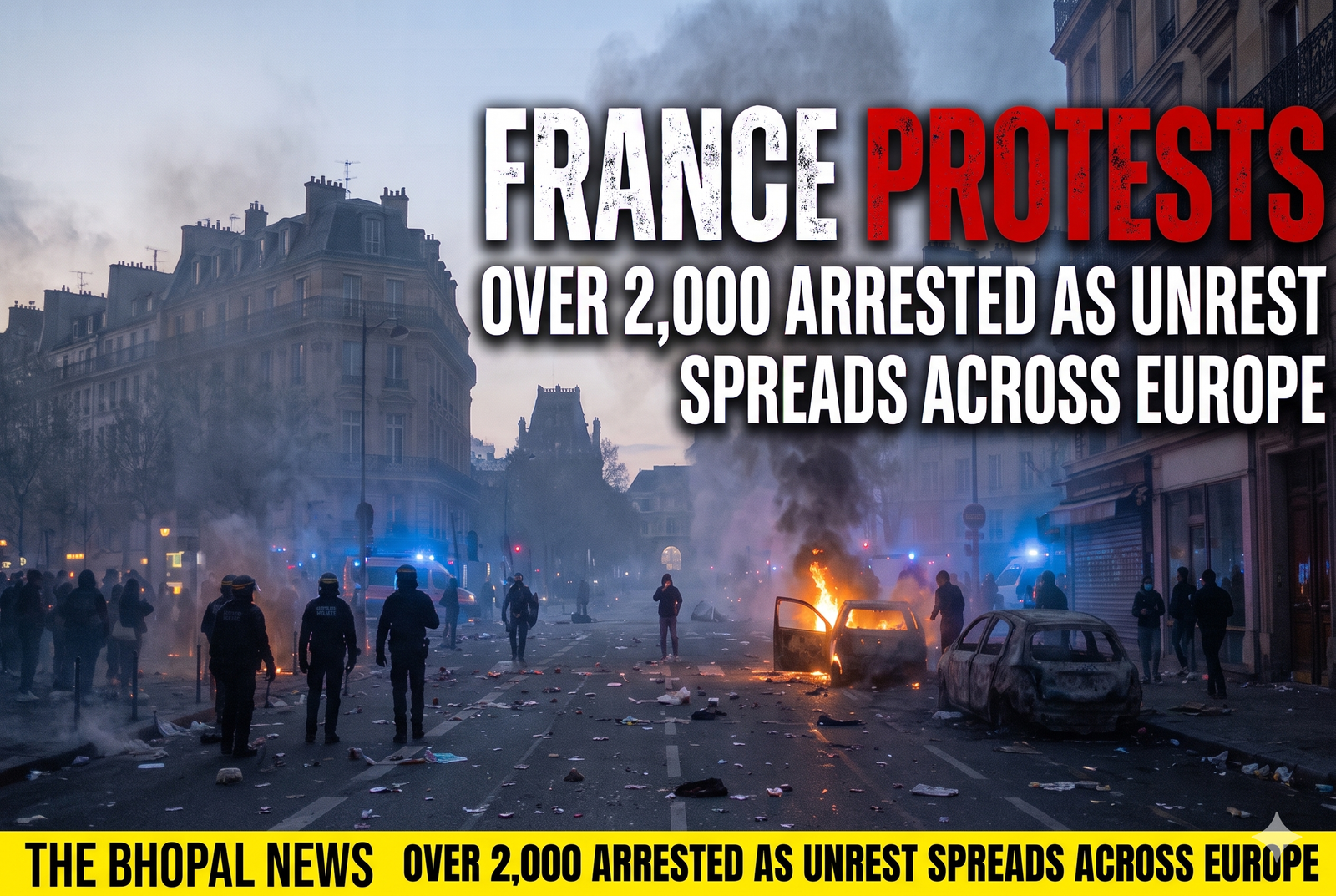
Violent France Protests have erupted crosswise the country, resulting in widespread street clashes and widespread ruin in major cities. Over 2,000 individuals have been taken into custody as security forces go to quell the escalating civil unrest. What began as a local demand for better school infrastructure rapidly intensified into an intense national anti-government movement. The momentum from last evening’s France Protests has now crossed borders, triggering similar cost-of-living and socio-economic demonstrations throughout Europe.
Violence and Destruction: Agitation in France
The streets of major French cities depict severe destruction. From burnt vehicles and broken store windows to walls covered in protest slogans, smoke continues to hover over major thoroughfares. Commercial spaces and large showrooms stand looted and empty, while police forces carry out widespread raids.
The protests initially began as a localised demand for basic amenities and increased staffing in secondary schools. It rapidly expanded into a broader anti-government movement. Over 2,000 people have been arrested across France following violent clashes between demonstrators and security forces. The movement has now breached French borders, stoking similar economic and social unrest across neighbouring European countries.
Macron’s Government Under Pressure
President Emmanuel Macron spoke to the people, pledging to discuss the issue and to take steps to curb high gas prices, but also saying that politics is not for the streets and should be dealt with in Parliament. But the administration is being criticised from both sides of the political aisle: Left-Wing Opposition: Jean-Luc Mélenchon (head of La France Insoumise) said that severe budget reductions and the use of hard police methods sparked public rage.
In response, Prime Minister Sebastien Lecourneau accused the far-left of fomenting anti-police sentiment among youth.
Right-Wing Opposition: Far-right leader Marine Le Pen, who criticised the government for its weak response to the rioters, also accused leftist groups of provoking street violence. The government in power is facing a situation where they don’t have a clear parliamentary majority, so it will be harder to pass structural reforms or emergency economic packages. The protests soon expanded across Europe. The protests quickly spread throughout Europe.
Protests Spread Across Europe
Given the turmoil in France, a number of its neighbouring countries with similar structural issues have seen economic and civic protests: Labour unions and student groups staged strikes in French-speaking regions in Belgium due to higher education budget reductions, tax changes, and changes in working hour regulations.
Italy: Demonstrators marched in Milan against low wages and high housing costs. After violent incidents that resulted in confrontations with security forces, Prime Minister Giorgia Meloni condemned the “uncontrolled development of events.
Greece: Students of University and high school organized barricades in front of the Parliament in Athens to call for subsidies for transport, food, electricity and affordable housing for students.
In Tirana, Albania, anti-corruption protests sparked by the lack of economic growth and the controversial land development projects resulted in some violence near the government ministries. Eviction of long-term elderly residents by investment funds led to demonstrations in more than 50 Spanish cities due to high rents.
Conclusion
The need for improved school provisions, which started as a local issue, has spread to the national agenda and become a political and economic debate for the French government. Facing mounting pressure to tackle system inflation and public discontent, President Macron is under pressure to step up in a divided parliament and over public debt, fiscal deficit rules. The next few months will be a difficult period to assess the political stability and economic strength of Europe, as unrest spreads to the continent’s various cities.