

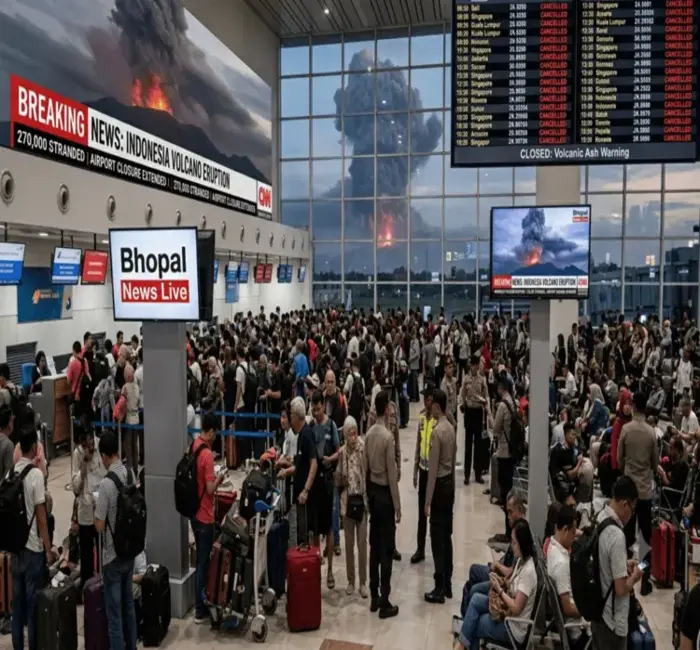
Indonesia volcano eruption disaster has mushroomed into a global travel travesty. Transport authorities confirmed up to eight airports, including the main international airport in Jakarta, have continued to close because of the lingering ash clouds that blanket important flight paths.
Over 270,000 Passengers Stranded as Airports Extend Shutdowns
Historically known for its strong eruptive periods, Mount Anak Krakatau started to exhibit heightened seismic activity late Friday night. The eruption, which had been fairly quiet until recently, quickly surged in intensity, with lava fountains leaping from the crater and copious amounts of ash thrown into the atmosphere. The volcanic ash ascended to a maximum height of 15,000 meters to the Java side and up to 6,000 meters to the Sumatra and Banten province sides, Indonesia’s Geological Agency and the Meteorology, Climatology, and Geophysical Agency (BMKG) said.
Commercial planes are seriously endangered by volcanic ash. Volcanic ash is made up of tiny glass shards and ground-up rock that are different from what is found in regular, everyday dust found in the atmosphere. The particles fuse at high temperatures when drawn into the jet engine and attach to the inner surfaces, resulting in complete engine failure during flight. So, air traffic controllers promptly shut down air traffic in affected airspace.
More than 270,000 Passengers Stranded as Airports Extend Closures. More than 270,000 passengers stranded as airports extend closures due to COVID-19.
The inexplicable and extensive shutdowns have resulted in overcrowded terminals. Over the past 48 hours, more than 2,000 domestic and international flights have been grounded or delayed. People are lining up in groups within the terminals waiting to receive hotel vouchers, rerouted tickets or flight reimbursements, often in snaking lines.
The main epicentre of the travel disruption is focused around the Jakarta, Indonesia volcano eruption response. The airspace over the capital was filled with ash, and flights at both Soekarno-Hatta International Airport and Halim Perdanakusuma Airport were suspended.
The key regional impacts on flights are:
This included the grounding or delay of more than 960 flights from across the country that were at Soekarno-Hatta International Airport alone, affecting nearly 30,000 passengers in the early stages of the airport’s closure.
Regional Cascades: Further closures were imposed in regional hubs of West Java province and Lampung province due to the regional transport of ash plumes.
International Routes: Numerous cancellations and delays were reported on long-haul and regional routes that travelled from Indonesia to major transit hubs such as Singapore, Sydney, Kuala Lumpur and Doha.
Flights to and from popular tourist destinations such as flights from Jakarta Airport to I Gusti Ngurah Rai Airport, Bali saw widespread cancellations from many airlines, including Garuda Indonesia, Citilink and AirAsia.
Government and Aviation Response to the Emergency
Assessing the airspace is being done by conducting safety tests every 30 minutes, confirmed Minister of Transportation Dudy Purwagandhi on Tuesday. Since the weather conditions are dynamic and the wind direction is different in various months, it is impossible to know exactly when all the restrictions will be lifted, transport officials said, noting that safety for passengers is the highest priority.
The government has advised travellers not to come to airports unless confirmed by their airlines. Meanwhile, emergency help desks and temporary rest zones have been set up in the corridors of the airports to accommodate thousands of weary families and international visitors stuck in transit.
Local authorities close to the Sunda Strait have issued health alerts. People from local coastal communities have been advised to wear protective masks as they go outside since the ash is affecting the respiratory system. The Geological Agency has issued a new warning that explosive eruptions could occur again at Mount Anak Krakatau any time in the next few days and continues to enforce an exclusion zone around the volcano.
Real-Time Updates on the Indonesia Volcano Eruption Today
The information from the volcano eruption in Indonesia today is continuing to spread across the world, and various international travel agencies and diplomatic missions are watching the updates from Indonesian disaster management authorities. Preparations are being made by foreign governments to revise travel warnings for their citizens who are scheduled to depart from or pass through Indonesia. Foreign governments have been preparing to update travel warnings for citizens who are set to travel out of or through Indonesia.
The situation with airport closures due to the volcano eruption in Indonesia is still uncertain for millions of travellers. There will be some flights taking off during clear periods, but full operational recovery throughout Indonesian airspace will rely on the speed at which Mount Anak Krakatau cools, and wind currents disperse the smoke and haze.


