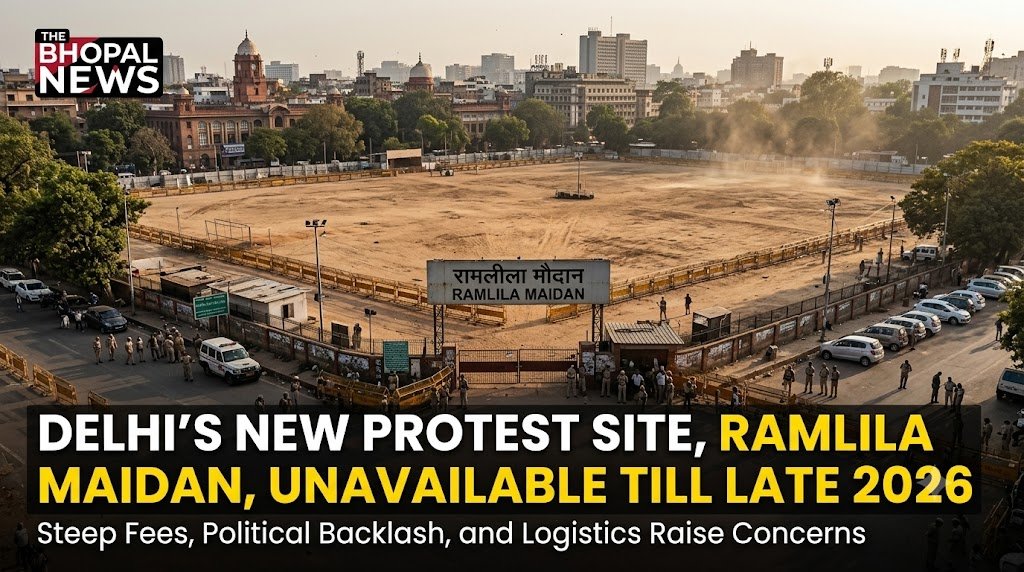
New Delhi: Ramlila Maidan, recently designated as one of Delhi’s main original venues for public demonstrations and protests, has run into direct operational hurdles. Rendering to civic officials, the historic 12-acre ground has virtually no open dates for the next two and a half months, leaving only December 29, 30, and 31 open for booking through the end of the year.
The venue became a designated demonstration site after an October 11 standing order issued by Delhi Police Commissioner Anurag Kumar de-notified the long-standing protest hub at Jantar Mantar. Under the new arrangement, Ramlila Ground, Burari Ground, and CBD Ground in East Delhi were named as the official replacement locations, with revised Standard Operating Procedures (SOPs) set to be issued separately. Kapil Sibal held a press conference with CJP leaders on providing legal aid to protestors who are being unjustifiably targeted.

High Costs and Limited Capacity Spark Debate
Municipal officials confirmed that festive bookings, including Dussehra and Diwali celebrations, dominate the calendar during the final months of the year.
The venue was declared a standing protest area after the Delhi Police Commissioner Anurag Kumar gave a standing order on October 11, de-notifying the protest hub, Jantar Mantar. The new deal has designated Ramlila Ground, Burari Ground and CBD Ground in East Delhi as the official sites, and they have recently issued revised Standard Operating Procedures (SOPs) for each of these venues.
Because of the high cost and limited capacity, debate was sparked around the subject.
While peaceful demonstrations were non required to pay any fee to be held at Jantar Mantar, the same cannot be said for Ramlila Maidan. The cost of booking the 12-acre ground is ₹50,000 per day, and the security deposit is refundable at ₹55,000. When the mandatory taxes are added, organisers have to pay ₹1.21 lakh per day initially.
Civic officials have explained that a small portion of the ground is still available for small events, but will not accept bookings for more than 150 people. The entire ground can welcome up to 50,000 visitors, said civic officials, but that would leave the civic body at a loss of at least ₹50,000 per day if the fees were waived.
The setup has been condemned by protesters and politicians. AAP Delhi President Saurabh Bharadwaj commented harshly on X (formerly Twitter) about the impracticality of the plan due to the ongoing festival season:
Two Ramleelas are happening at Ramleela Maidan; the Govt. has played another fraud on its citizens. How to have a protest here? Do they wish to cause disturbances?
Municipal authorities have revealed that celebratory events such as Dussehra and Diwali are the predominant events in the calendar in the last few months of the year.
Traffic and major Challenges
The Ramlila Maidan is situated in a busy commercial area surrounded by three major hospitals and civic administrative buildings, which often cause disruptions in the area’s traffic. Asaf Ali Road is often used for one-way traffic by police and rerouted to Jawaharlal Nehru Marg to ease traffic. Recent experiences in the area, including a 2014 political rally that jammed traffic on a Sunday up to ITO (almost 4 kilometres away and back) illustrate the continuing infrastructure problems in the region.
Delhi political core and Commerce
Originally a pond until 1930, the area was filled to host annual Ramlila performances starting in 1932. Post-independence, it evolved into a landmark public forum:
- 1952: Syama Prasad Mookerjee launched his satyagraha for Jammu & Kashmir’s full integration into India.
- 1956–1957: Prime Minister Jawaharlal Nehru addressed massive public assemblies.
- 1961: A permanent stage was built for a public reception in honour of Queen Elizabeth II.
- 1975: Jayaprakash Narayan and Atal Bihari Vajpayee addressed a historic rally on June 25, the day the Emergency was declared.
- 2013: Arvind Kejriwal took his oath of office as Delhi Chief Minister at the site.
Conclusion
While Ramlila Maidan’s historical stature makes it an iconic assembly ground, high daily fees, limited booking availability, and severe local traffic constraints pose significant challenges for organisers seeking a public voice in the national capital. Balancing civic revenue, traffic management, and the constitutional freedom to assemble will remain a delicate task for Delhi authorities in the months ahead.